A curriculum your team learns, owns, and keeps.
650 pages. 7 phases. 35 years of field testing. Here is the full breakdown.
All new organizations start with Phases 1–2. Each phase builds on the one before it — enrollment in a later phase requires completion of all prior phases. The modules are supplemental tools that reinforce the core curriculum at any phase.
Before you read the breakdown
How the curriculum is organized.
The curriculum has two distinct components. Understanding the difference will help you identify where your organization starts and what you're building toward over time.
Seven phases of structured, sequential curriculum developed over 35 years of consulting practice. Phases build on each other — you cannot enroll in Phase 5 without first completing Phases 1–4. Phases 1–2 establish the foundation. Phases 3–7 refine, deepen, and sustain it.
Most organizations begin here, with Phases 1–2.
Four focused, standalone learning tools that reinforce the Core Offerings. Modules are not a replacement for the sequential phases — they target specific areas of development and can be used to accelerate adoption at any point in the program.
Think of them as depth charges that support the broader implementation.
How phases work
Each phase builds on the one before it. There are no shortcuts.
This is not a menu. You cannot select Phase 5 because it addresses the challenge your organization is facing right now. The curriculum is sequential by design — each phase installs the infrastructure the next phase requires. Trying to skip phases is like trying to install the second floor of a building before the foundation is set.
This is where all organizations begin. Phases 1–2 build the documented infrastructure — every role defined, every procedure written, every BaseWork Center™ functioning. This is the most complete and well-developed year of curriculum we offer. It stands fully on its own and produces permanent results whether or not an organization continues to later phases.
Each subsequent phase refines, deepens, and sustains what Phases 1–2 built. Phase 3–4 moves from documented infrastructure to disciplined daily execution. Phase 5 formalizes analytical leadership. Phases 6–7 complete the living system — a University of Tomorrow™ where quality, leadership, and learning are permanently embedded in the organization. Each phase requires all prior phases.
Not sure where your organization is in relation to these phases? Take the free 4 Barriers to Quality assessment → It identifies your current state and tells you exactly where to begin.
Is this the right fit?
Who this curriculum is designed for.
The methodology works across industries, organization sizes, and operational contexts. If your organization has people, processes, and the commitment of leadership — it can work for you. The four barriers to quality are the same in every environment.
Companies growing 15–30% annually that need infrastructure to sustain momentum without breaking under their own expansion.
Organizations in 1–14% growth that are stuck reaching the next level and need a repeatable operating model to build from.
Pre-acquisition audits, ownership and leadership succession, and preparing the next generation to run the business with documented systems rather than institutional memory.
Agencies and institutions where accountability, documentation, and staff development are essential — and where the curriculum's values foundation aligns with public-service culture.
Founders building from the ground up who want to install the right infrastructure before bad habits become expensive. Individual enrollment is also available.
Pre-acquisition reviews, divestitures, and asset-management audits where documented systems and accountable infrastructure are essential to valuation and transition.
The curriculum has been applied across manufacturing, distribution, higher education, government, oilfield services, specialty contracting, healthcare, and professional services. The methodology is industry-agnostic. The problems it addresses are not.
Before you compare programs
What makes this curriculum different.
Most training programs deliver content. This curriculum builds infrastructure. That distinction determines whether what you invest in lasts or disappears when the facilitator leaves the room.
- Deliver information in a structured format
- Measure success by attendance or test scores
- Produce certificates confirming completion
- Leave when the facilitator does
- Require ongoing re-engagement to stay relevant
- Builds infrastructure inside your organization
- Measures success by documented outputs — procedures written, systems functioning
- Produces credentials confirming competency
- Leaves capability behind when the engagement ends
- Sustains indefinitely through Intinuous Deployment™
The curriculum is built on a foundational conviction: every person in an organization wants to do good work. What they lack is the structure, documentation, and training to make that possible consistently. The four pillars — Foundational Values, Ethics, Business Practices, and Foundational Arts — are not decorative. They are the operating system beneath every phase.
BaseWork Systems — core offerings (BW/S)
The seven-phase curriculum, in order.
Read these in sequence. Each phase describes what your organization builds on top of everything the previous phase established. We recommend starting here, with Phases 1–2.
This is where every organization begins. Phases 1–2 move your team from informal habits and undocumented practices to a fully defined, documented, and accountable quality infrastructure. Phase 1 covers executive alignment, role definition, and BaseWork Center™ documentation. Phase 2 formalizes execution, problem-solving, and organization-wide quality systems. Phases 1–2 stand fully on their own — an organization that completes this phase and goes no further will have permanently transformed how its people work, communicate, and hold each other accountable.
Select this courseTransitions the organization from documented infrastructure to disciplined daily execution. With the foundation in place, Phases 3–4 introduce operational discipline tools, structured communication, and reinforced leadership accountability. The systems your team built in Phases 1–2 are now stress-tested, refined, and stabilized across every BaseWork Center™.
Select this courseWith disciplined execution established, Phase 5 moves into data. A structured month-by-month audit progression — covering up to 15 standardized forms and advanced performance monitoring disciplines — formalizes how the organization measures, analyzes, and reduces variation. Leaders at every level develop the skills to make data-supported decisions consistently.
Select this courseThe final phase of the curriculum completes the living system. With documented infrastructure, disciplined execution, and analytical leadership all in place, Phases 6–7 expand leadership capability, embed cultural stability, and establish long-term sustainability. At this stage, the organization becomes a University of Tomorrow™ — a living learning system where quality, accountability, and growth are permanent and self-sustaining.
Select this courseNot sure which phase is right for where your organization is today? Take the free 4 Barriers assessment → It identifies your current state and tells you exactly where to begin.
BaseWork Modules — focused, standalone learning (BW/M)
Four modules. Targeted depth. Any phase.
Modules reinforce the full BaseWork Systems™ implementation. Use them to target specific development areas or accelerate adoption of systems-based thinking at any point in the program. They work alongside the Core Offerings — not instead of them.
Guides team members from a general understanding of their job to a structured breakdown of recurring responsibilities. Introduces the principle that all work must be observable, repeatable, and capable of review.
Develops personal accountability by connecting clearly defined responsibilities to quality execution. Trains individuals to actively manage, plan, schedule, and monitor their own work in alignment with organizational standards.
Advances from defined work to measurable, controlled performance. Responsibilities are evaluated through data, metrics, and verification. Execution is monitored, analyzed, and continuously improved through facilitated learning and team application.
Integrates training, application, and continuous improvement by connecting structured learning to real-world execution. Defines and documents each role's duties, performance standards, and accountability expectations through structured reviews and system audits.
The progression
How the phases build on each other.
The pyramid below shows the progression from foundation to full leadership integration. You can only reach the top by building from the bottom. Phases 1–2 are the base — everything above depends on what they establish.
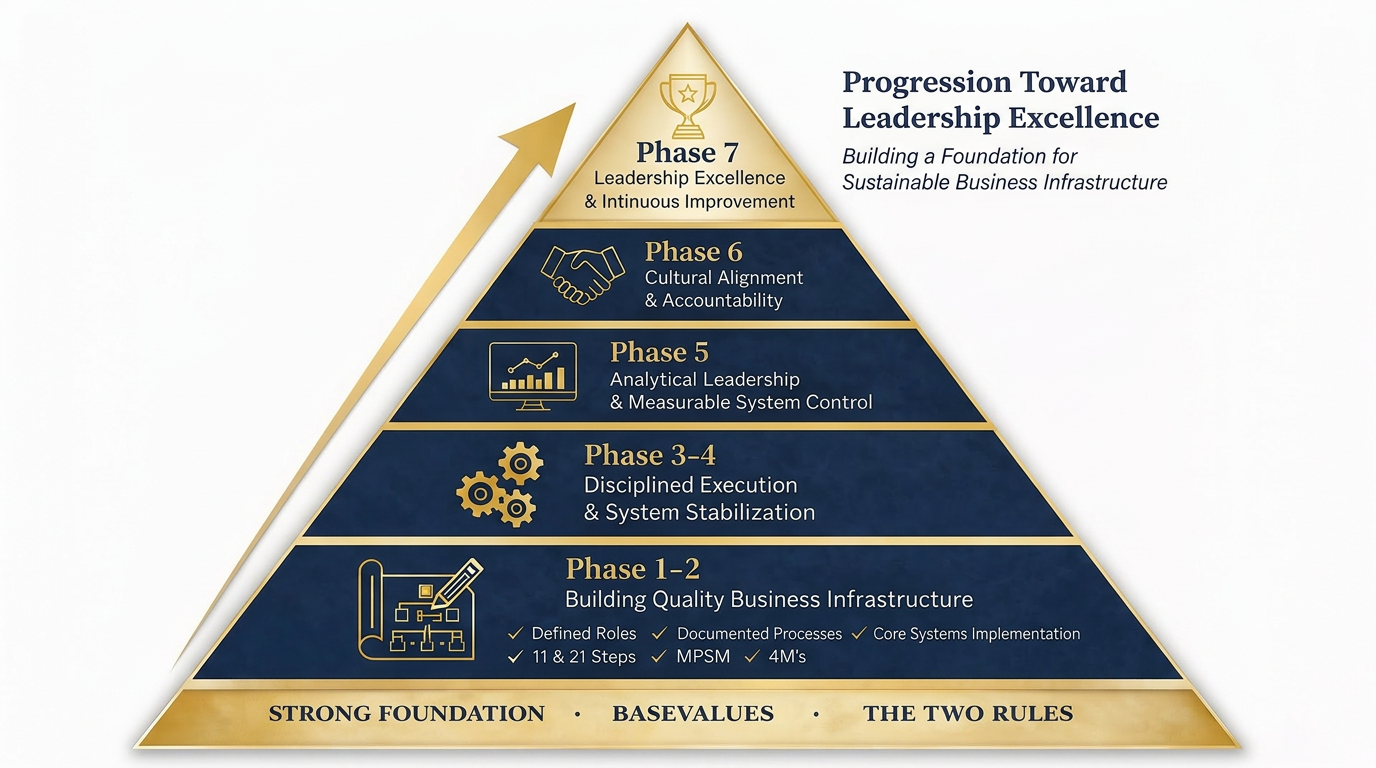
At the peak, the organization operates as a University of Tomorrow™ — a living system where leadership is distributed, quality is embedded in daily work, and learning never stops. The curriculum gives you the path. You bring the commitment.
How you access it
Three ways to run the curriculum.
The full curriculum is available in the format that fits your organization's existing schedule and infrastructure. You choose the delivery pathway that matches where you are — no need to pause operations or install new technology.
Self-paced or live virtual delivery for distributed teams or organizations that want to start immediately. The full program is accessible from anywhere.
BSG facilitators on the ground with leadership and team members for organizations building training infrastructure who want hands-on setup support.
Combine online delivery with periodic on-site facilitation to balance scale with in-person guidance at key milestones.
Investment starts at $430/month for a 10-person organization, recurring over the 26-month Phases 1–2 program.
Pricing scales with your team size. Use the calculator on the Pricing & Enrollment page to get your exact number in 60 seconds.
The cost of standing still
Four numbers, and you'll see what your current structure costs each year.
Run the numbers →Pricing and enrollment
Full breakdown by headcount, with add-ons and one-time fees.
See pricing →Request a free consultation
No obligation. A focused conversation about fit.
Start the conversation →